When stuck, be generous

Feeling stuck? Lacking motivation? Unsure of what is true?

Make a gift. Do something generous. Get back to who you are and give something generous.

For me this looks like calling a friend, writing a letter/postcard, making a little trinket for someone, sending someone a book with a note in it, offering a few coaching sessions to someone doing work I care about.

When I give, I find more of myself.


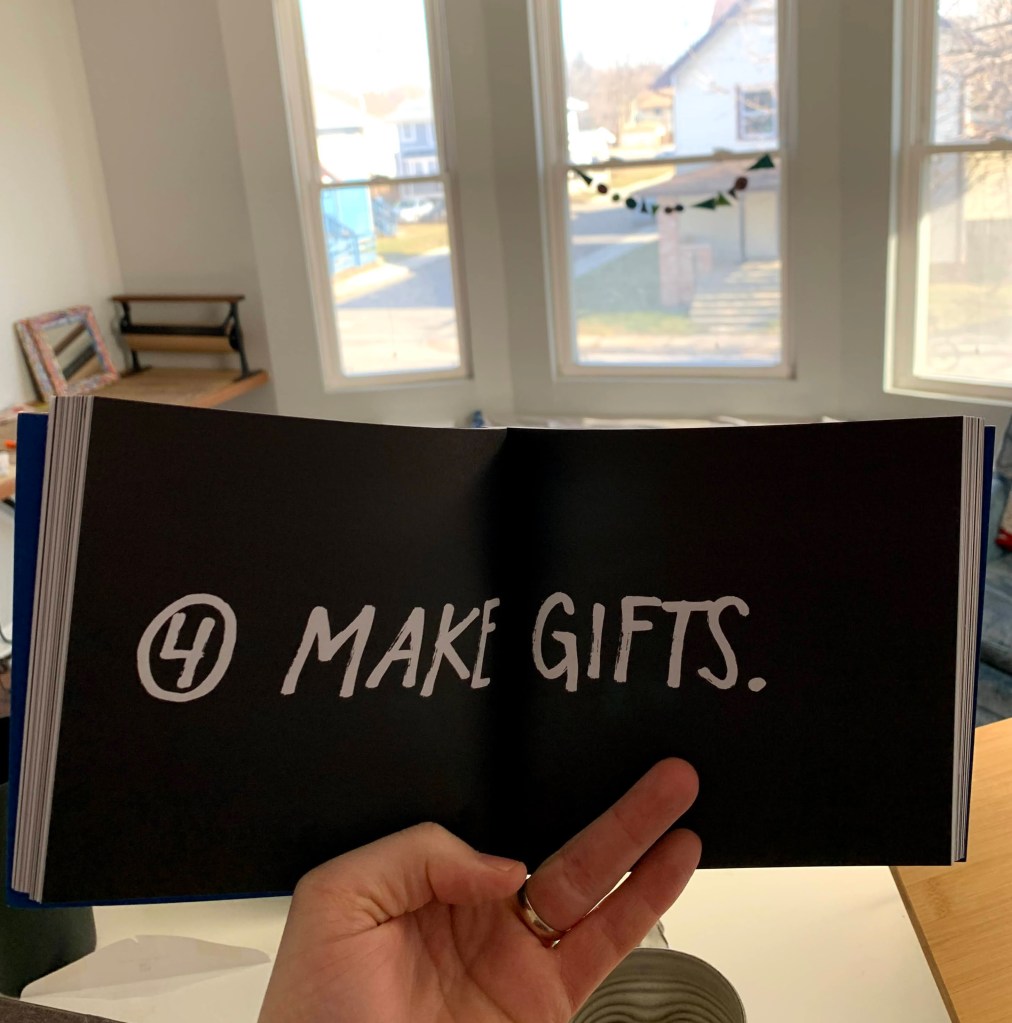
Austin Kleon’s Chapter 4 from Keep Going

Inspired by Austin Kleon’s Keep Going book.

Shallow

“Shallow”…an important word to consider and internalize regularly.

How much of my work is shallow?

Based on metrics such as # of likes, # of emails sent, hours in meetings, how many people talked to.

How many of my relationships are shallow?

Inauthentic. Transactional. Based on insecurities.

How could we make some of these less shallow?

“…and the future is up to us!”

“…find my freedom, my future, my purpose. I am a detective. I’m a decipherer. And I’m a finder of lost souls. My life is my own. And the future is up to us!” – Enola Holmes from the 2020 Film

Who are you?

If we are to make the future, we must start with ourselves. Who are we?

What are your “I am…” phases?


A life theme is one thing. Mine is “Invoking people’s truest selves.” Identity is another. I used to say Energy – Connection – Cultivating which I would say are my strengths. Who am I though?

I am an energizer. I’m a connector of ideas. And I’m an advocate for people’s truest selves.

Gratitude Practice

Set a timer for 5 minutes.

Think of a person you work with, serve, lead, care about.

Think of things you’re grateful for of that person. Even as critical thoughts come through, simply release those and grab onto moments of gratitude for that person.

Don’t hesitate to transition your thoughts to someone else. Repeat for that person.

I’m doing this each morning for a week to think about the people on my team, clients I’m working with, friends in my life.

So far it has been a great practice as I get ready for an important meeting. If I find 5 minutes between transitions, do this practice thinking of the people in that next meeting. I’m showing up more productive, more generous, more focused, overall better.

Space and Time Work Different When Distanced

When in person in a meeting or classroom it takes a few extra seconds of silence to erase the whiteboard. Everyone sits in anticipation and respect for the time to erase. Virtually, we don’t design meetings to have many pauses.

When someone doesn’t speak up its noticed because they have a physical space the physical space they take up doesn’t provide input. Virtually, we don’t have a physical space to associate people with so we can go by unnoticed in a meeting.


When someone is speaking and then takes a beat to think more, everyone waits for them because the presence they take up demands respect. Virtually any little pause is room for someone else to get their comment in.

A lot of this comes down to respect. In person, we know how to do respect. It’s built into our culture and experiences. Virtually, we need to build it in. Work a little harder to design for respect.

For example, when I’m transitioning a meeting to a new topic, I’m going to ask a general question to allow for people to stop and think. As I’m leading a meeting, I’m going to list out on a paper all the people in the meeting and keep an eye on it…maybe even I should make trading cards for those I interact with often, giving them a physical space. When I’m listening to someone and they take a beat, I’m going to assume they are thinking about more to say and wait.


Some of this idea was sparked by John Maeda’s Redesigning Leadership chapter on Technologist as Leader.

Curiosity Leads to Generalist

As we are driven by genuine interest to curiosity and that leads to learning, inevitably we will widen out our knowledge and experience base.

Actually being a generalist (good at a lot) is sort of being a specialist. Seth Godin uses the idea of a Swiss Army knife. It does a lot of different things and therefore is specific.

This learning builds in flexibility. Nimbleness. Ability to respond “no problem” with most requests.

As knowledge sharing increases and organizations become more decentralized, it will be less important to be singly specific. It’ll be more important that we all become generally specific. Good at a lot so we can take the knowledge easily accessible and find a way to apply it effectively.

It’s less about what you have and more how you apply knowledge or information in general.


Inspired by Seth Godin Akimbo podcast episode “Go Invent Something” Q and A at the end.

Data I found through Harvard Business Review which points to generalist being more able to apply knowledge than specialists.

Curiosity Needs Time and Space

Continually learning and growing is key to staying engaged in work, succeeding professionally, being our best.

We cannot expect to fill our entire day with back to back meetings or project time and learn most effectively.

We need at least a little time and space. Not hours on end to read a book, but maybe. Not years in a career to complete a degree, but maybe.

I’m more so talking about 15 minutes after a meeting to reflect and grow. 5 minutes to let your head dream and drift. 30 minutes to journal or write each day.

I’m also not just talking about time. A workspace that allows for you to observe and see things clearly. Rhythms in your day that set you up for clarity. Relationships that challenge you beyond the what did you do but how did you feel, what does that mean for where you’re going.

For example, I’m trying to schedule each day with at least 30 minutes outside of lunch to sit in my comfy chair and read or think. I also start my day with 5 minutes of mediation. I end my work day with 15 minutes of journaling at a separate desk in my office designed for analog processing…think big paper, post it notes, colored sharpies, and scissors.

Of course we can learn even in the midst of back to back but I find I learn best with a little time and space. And I find I have to fight for that time and space…or at least proactively set it up.