Curiosity Leads to Generalist

As we are driven by genuine interest to curiosity and that leads to learning, inevitably we will widen out our knowledge and experience base.

Actually being a generalist (good at a lot) is sort of being a specialist. Seth Godin uses the idea of a Swiss Army knife. It does a lot of different things and therefore is specific.

This learning builds in flexibility. Nimbleness. Ability to respond “no problem” with most requests.

As knowledge sharing increases and organizations become more decentralized, it will be less important to be singly specific. It’ll be more important that we all become generally specific. Good at a lot so we can take the knowledge easily accessible and find a way to apply it effectively.

It’s less about what you have and more how you apply knowledge or information in general.


Inspired by Seth Godin Akimbo podcast episode “Go Invent Something” Q and A at the end.

Data I found through Harvard Business Review which points to generalist being more able to apply knowledge than specialists.
Curiosity Needs Time and Space

Continually learning and growing is key to staying engaged in work, succeeding professionally, being our best.

We cannot expect to fill our entire day with back to back meetings or project time and learn most effectively.

We need at least a little time and space. Not hours on end to read a book, but maybe. Not years in a career to complete a degree, but maybe.

I’m more so talking about 15 minutes after a meeting to reflect and grow. 5 minutes to let your head dream and drift. 30 minutes to journal or write each day.

I’m also not just talking about time. A workspace that allows for you to observe and see things clearly. Rhythms in your day that set you up for clarity. Relationships that challenge you beyond the what did you do but how did you feel, what does that mean for where you’re going.

For example, I’m trying to schedule each day with at least 30 minutes outside of lunch to sit in my comfy chair and read or think. I also start my day with 5 minutes of mediation. I end my work day with 15 minutes of journaling at a separate desk in my office designed for analog processing…think big paper, post it notes, colored sharpies, and scissors.

Of course we can learn even in the midst of back to back but I find I learn best with a little time and space. And I find I have to fight for that time and space…or at least proactively set it up.

Service Focused Communication For All

When we say things we often want to be authentic. Vulnerable. Real. True.

This is noble and ideal. We should show up and offer ourselves as we are.

It is also only half the equation of an interaction. It doesn’t necessarily look at the other parties in the conversation. How they receive the communication, what they hear, what they need.

We should shoot for authentic and valuable.

When something is authentic but not valuable to the other person we are just adding unnecessary noise to their life. Maybe we should consider not saying that authentic non-valuable thing.

When something is valuable but not authentic, we tip the scale towards unethical or manipulative. Sometimes we need to say something simply valuable to move the relationship onward but only if it’s for the best of both parties.

Being real, authentic, and adding value is the sweet spot.

This requires we consider the other. Think of the other person. Be service oriented. And that requires we take care of ourselves ahead of time.

Coaching: Helping Someone Solve Their Problem

Key word here: THEIR

Successful coaching is not about telling someone your view of what could be better or giving someone steps to follow. It’s about the person being coached.

They may have an idea of what better looks like. They may ask for your help in defining better. You may have to do some “marketing” to help them see and in turn own the better.

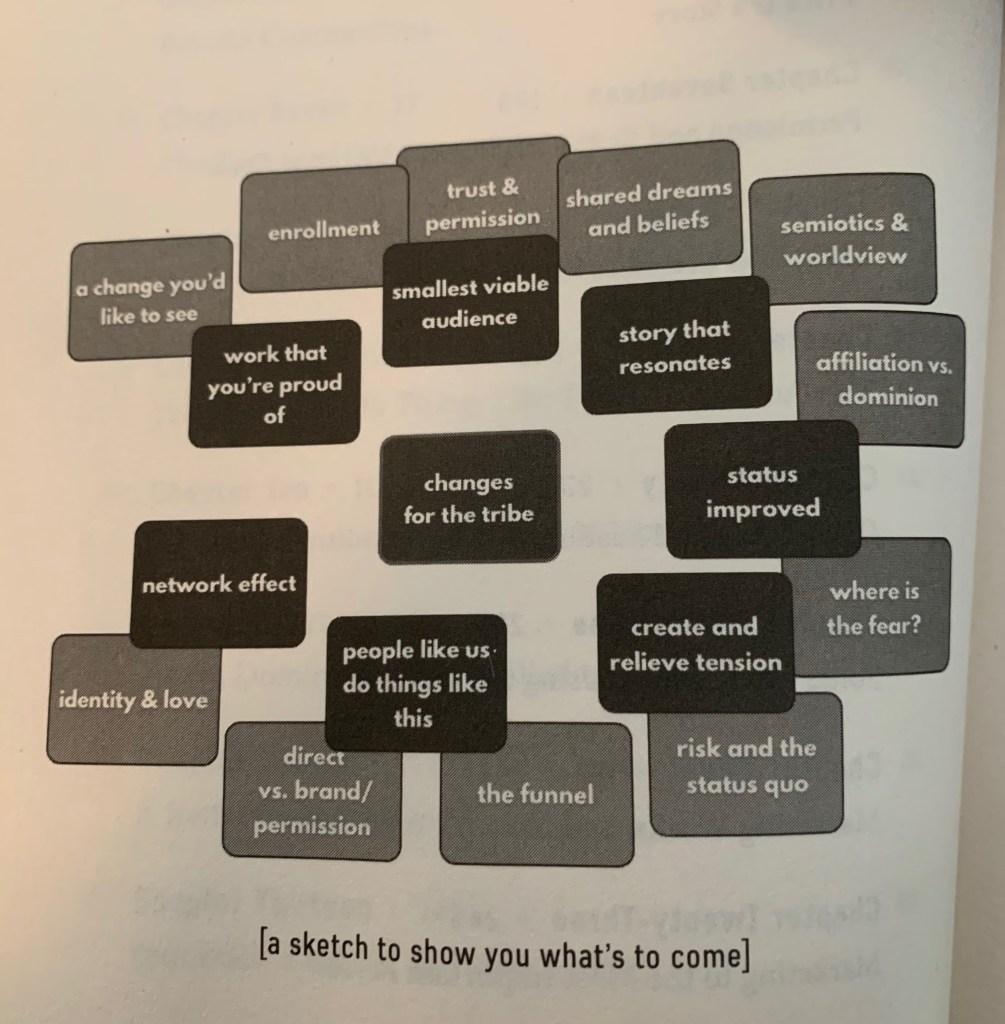
We can use stories, status roles, creating and relieving tension, build culture to help someone adopt and enroll in a journey.

This marketing is not about a website or a logo. It’s about designing the coaching experience for the coachee and helping them solve THEIR problem.


These ideas all are elaborated on in Seth Godin’s This is Marketing. I love the “table of contents” in image below!

Not Perfect, But Perpetual

All things have the possibility to fail.

I’ve learned that the earlier I recognize all things could fail, the better I do at managing along the way.

As we realize something could fail, emotions arise and threaten well-being and even possible success.

For example…If I’m working on a project and talk with a key stakeholder and realize the task has been attempted in the past without success. There is value in information about why it failed before but actually the main piece sticking out to me is realizing that I may fail.

When I recognize the possibility of failure early on, I buffer those strong emotions from clouding my judgement and ultimately my success.

True success is less about being perfect and more about being perpetual.

Less stress and worry. More grit and determination.

Often we know the next right thing to do. Often we are supported.

Let’s work to acknowledge possible failure early so we can buffer that fear as we go.

Find Value In Each Interaction

If you’re like me, the COVID-19 pandemic has taught you some lessons with experience.

I’ve had less and less interactions with people. I’ve noticed myself leaning into interactions with more enrollment and joy. Because it’s somewhat scarce.

This new normal is teaching me to find value in each interaction I have. I am now thinking how much value did I miss in interactions when I had even more each day. Going forward I’ll be leaning into each interaction.

Processing Critique

Feedback is so important developing yourself, relationships, and being effective. It’s essential for all three parts of my coaching framework.

Often we must intentionally open ourselves up for feedback. Ask specifically how you’re doing. Build a rhythm of critique and feedback. But also be ready to hear it.

I find a healthy way to hear feedback is to listen to someone else so you can then listen to yourself.

Not solely about someone else’s opinion but what that opinion causes in you.

Respond from who you are in the end. Of course you first need to get to know yourself but if you know yourself, you can hear feedback and then hear yourself.


Idea came from John Maeda and Becky Bermont’s book Redesigning Leadership

Innovate Inside of Relationships

Some people will appreciate the simply ship it attitude. The innovative spirit. The churn and refine. Those people need you to respond with clarity and vision. From me, those people need me to come prepared with succinct yet exciting engagement.

A second group of people will deeply loath the roll the dice, innovative spirit. They want process as usual. Only give me what I ask for. Top down control and oversight. From me, these people need me to come with specifics and clarity. I must do my homework and try to stretch their thinking a little but overall build trust from consistent reliability.

One common theme is that both these groups of people need me to be well prepared. I am an Eagle Scout and from my time in the Boy Scouts, I engrained the motto, “Be prepared.” Recognizing someone’s disposition and coming prepared to speak to that narrative. The narrative and stories we tell ourselves are reality not what we want people to be telling themselves.

While it is important to appeal and curate towards your audience, it is also important to curate your audience. Find people that value what I have to offer and go after them. Realize that what I have to offer is not for everyone. While also trying to stretch that circle of people little by little. Being a little bit of an evangelist for ideas and innovation while also going after the right people.

Overall, I hope to be more prepared and thoughtful in my relationships. Take risks to stretch a person’s perspective and when I do plan to stretch their thinking, I will come well prepared. Because that doesn’t happen with off the cuff interactions. I will also prepare by being thoughtful to realize those whom I can have the most impact. I must clarify who I am and understand who specifically will value and benefit from that.

I have distilled a personal life theme…”Invoking people’s truest selves.” What I must do is come prepared to offer that theme to others while also curating the right people to bring myself to.


This idea came after watching Guy Kawasaki’s TED Talk on the Art of Innovation

Problem with Authenticity

Being authentic is all about me. You. Individual.

Sure we want to be real, true, but also we cannot live in a space all about us all the time.

We need to also show up as a professional.

Serving those around us.

Start with authenticity to find yourself but know we also must show up for other people.

At least that’s the life I’m looking to live. One of a professional. One of service. One of love.


Seth Godin talks about this idea a lot. His episode on Akimbo (Episode “Industry and it’s disconnects” at 24:22 time) talks about it at the end in Q/A segment which sparked my thinking on it.