Understand the politics do not play in the politics because the worst thing that can happen is you’re labeled as political, which is a dead nail. So please do not embark and playing the politics. Just be cognizant of the politics.
This is from Part 2 of a two part series of interviews by Adam Grant with Indra Nooyi, the former chairman and CEO of Pepsi Co. Both interviews are worth a listen and specifically this concept of being cognizant of politics but not embarking on politics in the workplace.
Balance between being aware but not engaging. What a dance to do.
Excerpt from Fredrick Buechner’s Listening to Your Life
Buechner is describing sloth as what I understand as incessant flow.
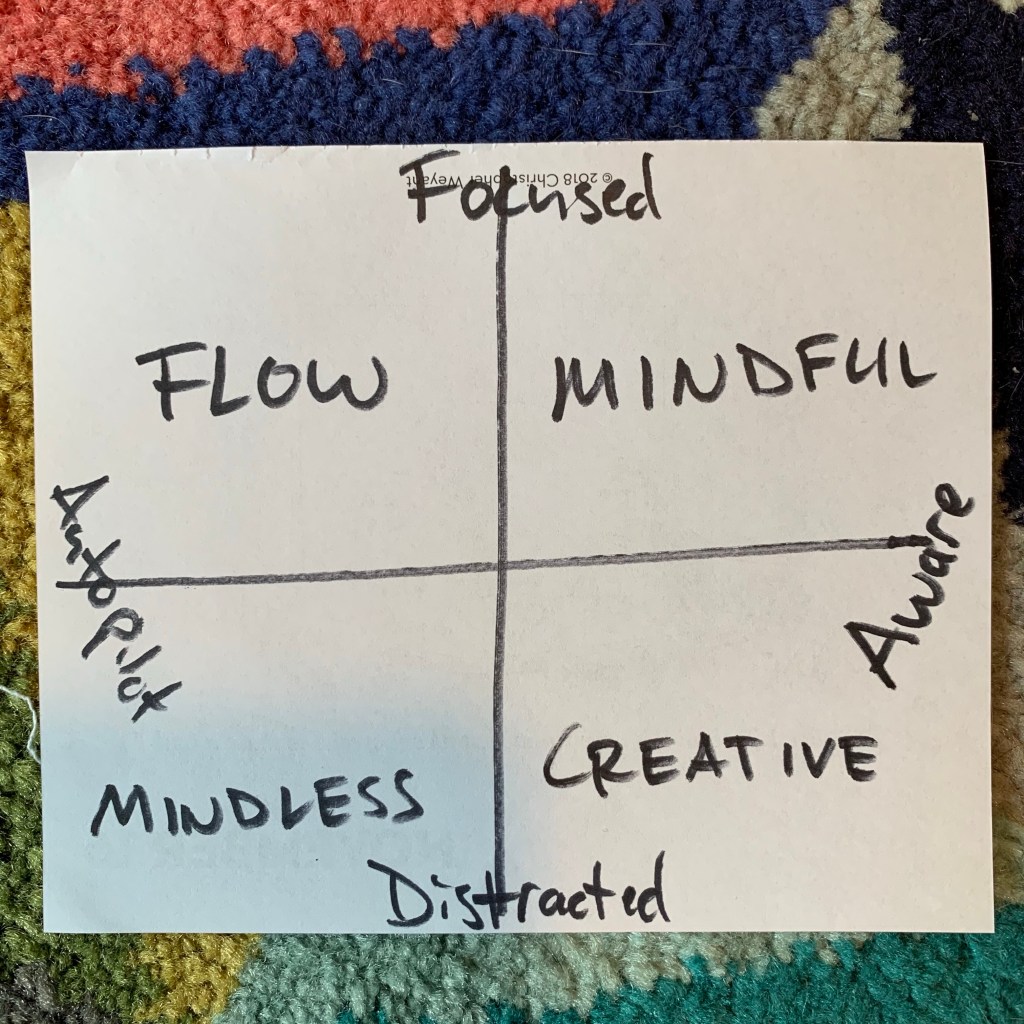
When we are focused but not aware. This is valuable in some instances (doing the dishes, tedious but necessary work…) but if it becomes a norm, it can derail and lower meaning in life.
The alternative is mindful. Focuses and aware. A mindful person can be seen as lazy sometimes because they take a walk after a complicated phone call. They spend extra time meditating each morning. They don’t rush out of a conversation.
Go take a walk
  It is easy to hear your own footsteps,
  the rustling of the leaves you kick,
  the crack of a branch you break.
Listen also to all that is beyond yourself.
  The breeze shaking the leaves,
  a creak of an old tree,
  the quip-quip-quip of an unfamiliar bird.
Be led beyond yourself.
  Sense and feel that which is other,
  consider from where it comes,
  acknowledge, honor, and respect it.
Think of a person you work with, serve, lead, care about.
Think of things you’re grateful for of that person. Even as critical thoughts come through, simply release those and grab onto moments of gratitude for that person.
Don’t hesitate to transition your thoughts to someone else. Repeat for that person.
I’m doing this each morning for a week to think about the people on my team, clients I’m working with, friends in my life.
So far it has been a great practice as I get ready for an important meeting. If I find 5 minutes between transitions, do this practice thinking of the people in that next meeting. I’m showing up more productive, more generous, more focused, overall better.
Stress we might feel. Frustration buried under the surface. Worry simmering around the corner.
These all hold us back from the freedom of good work and joy of a grateful life.
Of course stress, anger, and caution can motivate is to work effectively…
…but I’m talking about the stress keeping you in the office through dinner, the frustration that comes out on those you love, the worry causing you to check your work email when you can’t sleep at 1am.
Build a rhythm to address the emotional root cause. Addressing that will help separate from work or tasks through the day and lead to the life we really want.
I use mindfulness exercises, physical exercise, and journaling but you should find a rhythm that works for you. Only you can do it and I think we each must do it.
Of course our day’s are more than just a single thing.
I’ve found freedom and success doing just one thing at a time.
If it’s developing a training, I do just that for a time period.
If it’s watering the garden, I don’t worry about what’s next.
If it’s reading a necessary book, I do that and nothing else.
To keep it all straight, make a list. Pick one thing on that list. Set a goal and a time. And do one thing.
My most commonly used app right now is my timer app on my phone. “Hey Siri, set a timer for 15 minutes….34 minutes…3 minutes…
This lets me focus on that one thing because I know my phone will tell me when it’s time for something else.
My goal for that time, reading a certain number of pages, making it to a certain milestone in a project, knocking out all the dishes…this helps ensure it’s productive. When I don’t meet the goal, I set the timer longer or it is what it is for the moment.
List. Goal. Time. This has helped me with mindfulness…being focused and aware simultaneously.
We tell ourselves stories all the time. These narratives can be subconscious or we might be aware through mindfulness, journaling, reflection, outside perspective.
Once we realize we are telling ourselves a narrative that is not constructive to where we seek to go, we must replace it with a more ideal narrative.
I’ve found the practice of journaling to help with this.
I write out the current narrative I’m noticing. Cross it out. Write a more ideal narrative to replace it.
This ideal narrative doesn’t need to perfect or full proof. It simply needs to one little step better.
An example:
I need to do more to get to where I want to be. Who I am is enough and I am putting in the work to get to where I want to be.
What are you doing to figure out what you don’t know?
Are you insulated in a bubble that only tells you things you do know?
You can be even more fully yourself if you open yourself up to find out what you don’t know and grow from it.
I’m seeing that my friends matter in this. They must be people who challenge me and help me see the world anew.
My family can be this but yet often these relationship are insulating…they should be and they should be restful places. At times I get a good does of reminder of what I don’t know here.
Professional settings should be diverse enough and open enough that we are regularly challenged with our perception. Often though we don’t do this to ensure we don’t rock the boat. Maybe you’re keeping people from pointing what you don’t know here protecting yourself and being closed for input.
Coaching for me is a place where I’m reminded of what I don’t know. A third party who is an advocate for me but also an advocate for the better part of me. The part I don’t see or the insight I’m not aware of.
My default is to suppress and minimize my own emotions. They may get in the way of my reasoning. I don’t want to seem unreasonable.
But in reality skirting our emotions can be the thing that makes us unreasonable. Our emotions are there for a reason. They are there as attention magnets, to help us notice things. To point out where we might need to focus.
We do need to ensure to manage our emotions but we cannot get used to suppressing them.
Emotion assists with reasoning.
At times we may find it easy to notice and actualize our emotions. Put words or images to our emotions and know what to do with them.
Other times we may miss them entirely. If you sense there is emotion present but you cannot recall it to the front of your head, try to simply scan your body.
Scan your body inside and out. Take note what is there. Wonder what the emotion behind that noticing is.
Allow emotion to assist in your reasoning process.
Meditation or other mindfulness practices seem daunting. How can you quiet your entire mind!? I don’t have time to sit in silence!?
Each morning I make space for 5 minutes of meditation and it is a habit I cherish each day as a workout to increase my mindfulness.
Mindfulness helps us create an internal environment suitable for high effective work and living. Helps us regulate our emotions, build resiliency, increase our ability to focus, make us more aware of subtleties around us…
Meditation is a workout. It might even feel stressful at times. That’s the point!
While meditating we should improve our awareness and focus. We focus on a specific object (breathing, phrase…), notice when we lose focus, release that loss of focus, and gravitate back to original object of focus. It’s a workout!
Here’s a simple start to building your own mindfulness practice:
Set a timer for 5 minutes (or more)
Get comfortable sitting. Close your eyes or keep them slightly open.
Bring your attention to your breath. If helpful count each in and our breath and focus on the breathing or counting.
As you gain focus on breathing, lift your focus to what you’re thinking about. Think of it like watching cars move through a four way stop. Acknowledge those thoughts and consider how you feel about them. Notice those feeling and thoughts as if they are moving through the intersection and outside of yourself.
When you want to release a thought, simply imagine yourself blowing a bubble and release the thought and emotions as if they were a bubble floating away. If they come back, let them sit and then release them again.
Bring your attention back to your breath as needed and as your focus gets too busy.
Repeat the cycle.
The goal is to have a mental workout. Help your mind grow in its ability to be simultaneously aware and focuses.


 phil invites