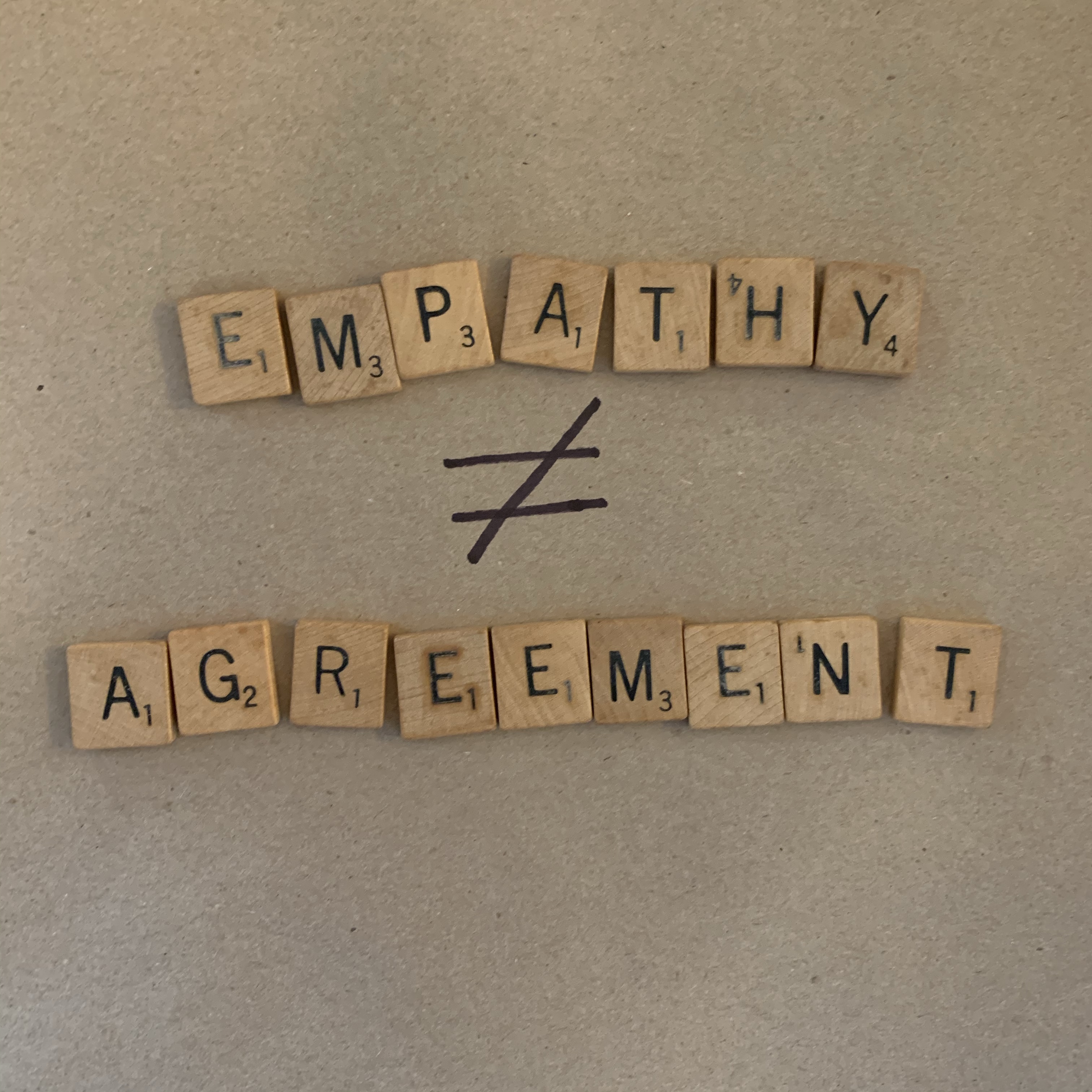
2 Reasons We Incorrectly Believe Empathy Means Agreement

Often I have thought that in order to empathize with someone, I must also agree with them. I realize now, it just takes more work to empathize with someone you don’t agree with.

Theresa Wiseman’s research describes empathy as four fold:

  1. See the world as others see it
  2. Understand another’s current feelings
  3. Non-judgmental or suspend judgement
  4. Communicate the understanding

I can think of TWO reasons we incorrectly believe that empathy equals agreement.

ONE: In high stress situations, our emotions rise to the front without as much regulation. Often I find that my emotions get in the way of these four attributes of empathy.

I may be angry and therefore display that frustration or hold onto that anger so I do not suspend judgement. I may feel hurt myself and therefore hold back the vulnerability to communicate what I understand of the other person.

We must find a ways to regulate our emotions. Ed Batista describes humans as “leaky” in that our emotions cannot be fully held back but we must be able to regulate them. Meaning we need to ensure the emotion we are expressing fits the surrounding culture, give ourselves time sand space to recognize early signs of our emotions to begin processing that, and identify where those emotions rise from in order to ensure we display them appropriately.

TWO: We think if we truly listen to someone else, we may actually agree with them and we don’t want to feel the shame of changing our mind. If we allow ourselves to empathize, it could be psychologically dangerous for us. So we equate empathy and agreement to avoid empathy.

Brene Brown describes shame at one end of a continuum and the other end of the continuum is empathy.

We can step closer to empathy by showing vulnerability ourselves. By demonstrating vulnerability, we allow for processing of our emotions and thoughts. Of course this must be done with tact and with appropriate regulation as described above. When used well, vulnerability can make a tense moment move towards empathy on all sides. If we can’t move it towards empathy, it will naturally go towards shame and get us away from truer understanding and appreciation.

Don’t let shame be the deterrent from more truth and wholeness.

If we hope to be empathetic, we don’t have to agree. Empathy does not need agreement to exist. We can see through a person’s lens, be non-judgmental (and yet still be vulnerable and regulate our emotions), understand someone’s feelings, and find ways to communicate back to them what we understand, all without agreeing with what they say.

Inspired by this idea from Ed Batista’s Self Coaching FREE Webinar recordings and his post dissecting Accountability and Empathy.

A Journal is a Key Tool

Just like a hammer is necessary if you’re framing a house. A drill is necessary to do woodworking. A key is necessary for opening a door.

A journal is necessary to developing ourselves.

We can use the back of a screw driver to knock in a nail every once and a while but if we have to hit nails day after day, we’d better have a hammer.

We might act similarly using our memory as the screwdriver to temporarily drive home our own development. Nothing replaces the act of journaling.

Journaling or keeping a diary is a reminder that development is more than a 1 hour every month thing. It is ongoing and process you will partake in every day. It can help you measure growth and development. Journals help you remember what was said or what you thought about. It is a place for you to collaborate with yourself and think as if there were two of yourselves processing information.

Rhythm is important.

If you do not know where to start, begin with gratitude or what you are proud of for the day and let it grow from there. It doesn’t have to ever be perfect or complete, it just needs to be you. It never needs to be shared or explained or just needs to resonate with you.

Inspired by Austin Kleon’s thoughts on why he keeps a diary

New Favorite Question!

What was most useful for you? (The Seventh of the Seven Essential Questions from Michael Bungay Stanier’s The Coaching Habit

Ask this question to yourself at the end of the day, at the end of a 1:1 meeting with someone, to a group you are working with or training or teaching, with a friend after you finish connecting or hanging out.

The power of this question lies in its optimism, it’s other focus, it’s directness, it’s reflective nature.

It concludes a conversation or interaction with assumption that there was something useful. This optimism leaves you and the other parties thinking of the good.

It directly states the value and gets to the point.

It helps us or those being asked to reflect on the experience and learn more deeply. This reflection and recall forces us to analyze and stops the forgetting process.

“What was most useful for you?,” embeds learning, extracts wisdom, and extracts what is useful.

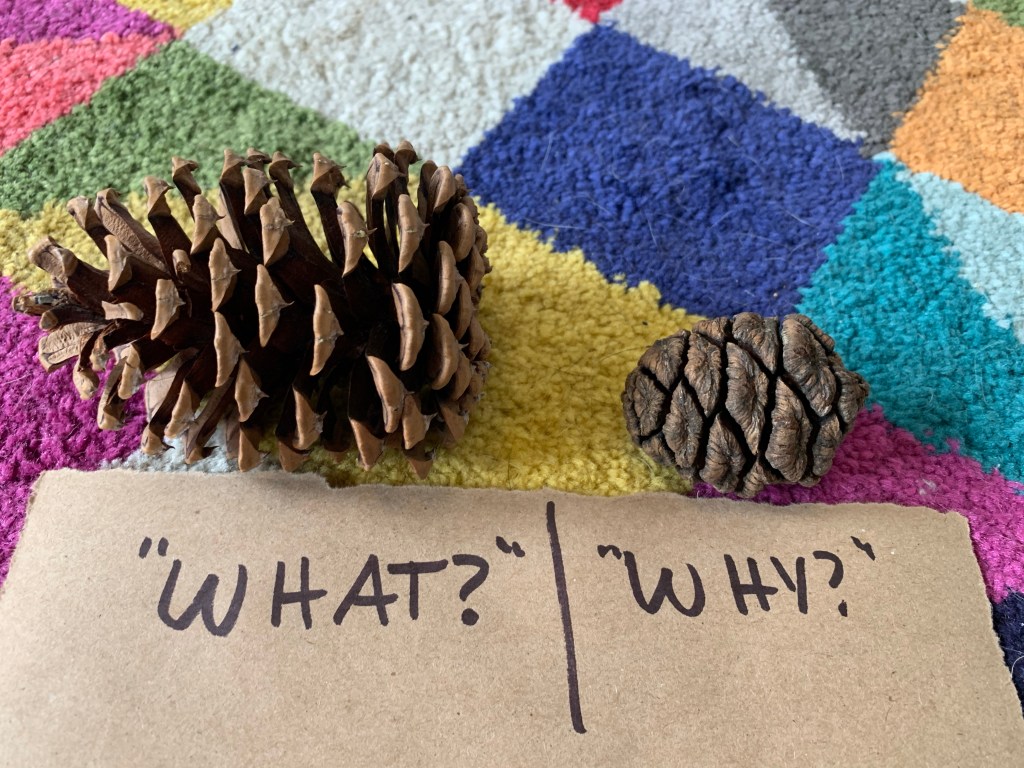
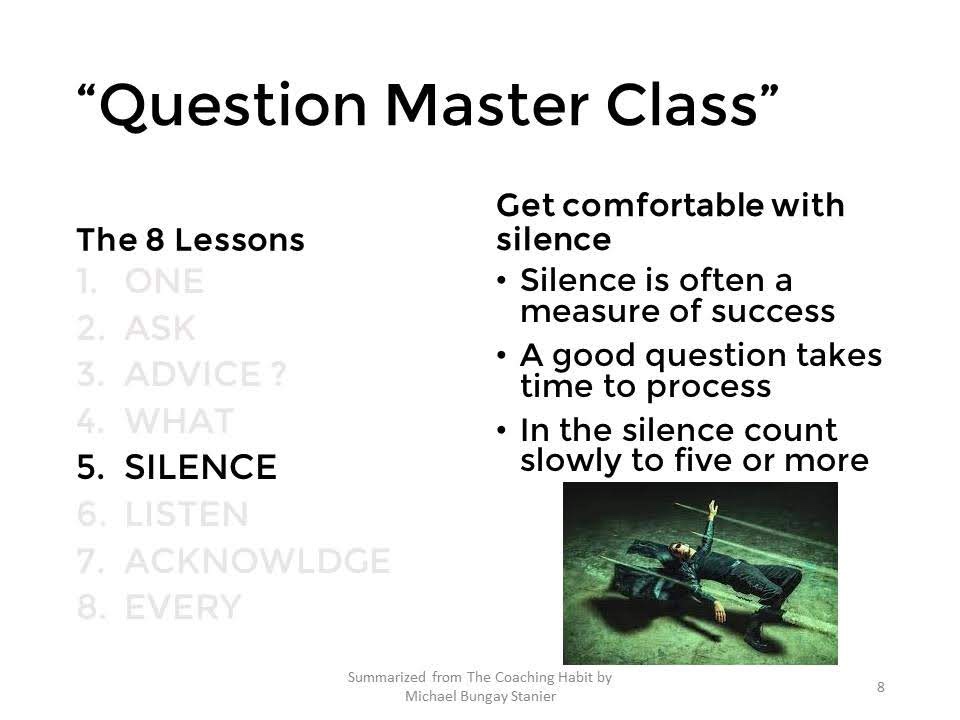
Stick with “What” Questions

I love a good “why” question but they aren’t the right question most of the time. Why can be ambiguous, come off as condescending and create defensiveness.

We should be asking more “what” questions.

What makes the situation less personal and more factual.

What invites an observant perspective to truly analyze what is going on rather than dig deep for some abstract answer.

What removes judgement you might have of a persons decision. It can put you both on the same team looking at the problem together.

I’m looking for ways to make sure my what questions are more frequent than my why questions.

Some examples:

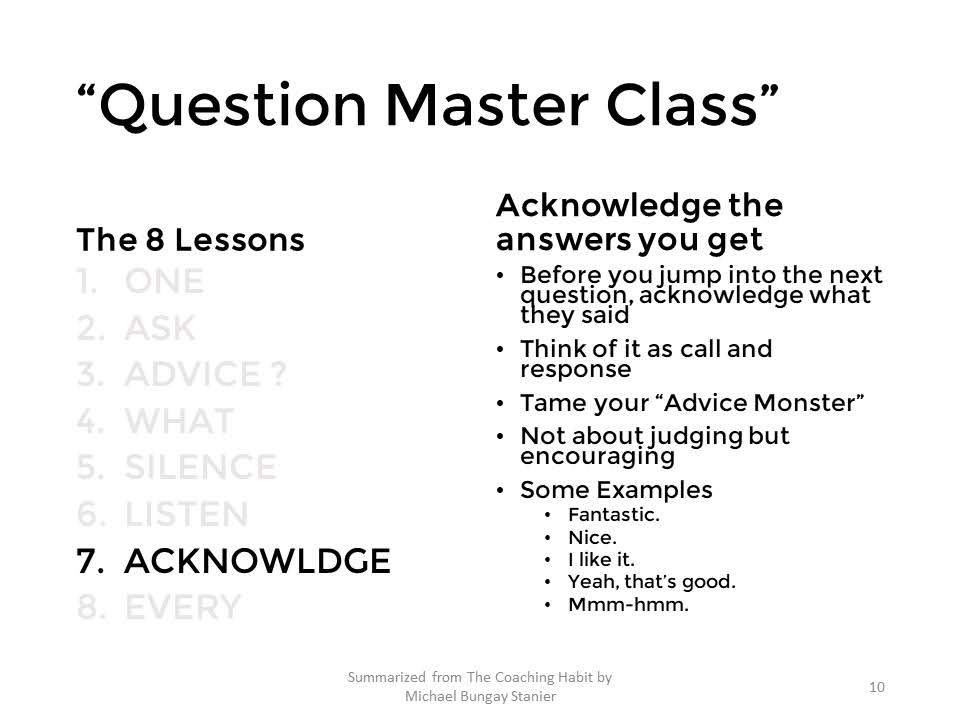
Why did you do that? —> What were you hoping for there?

Why did you think that was a good idea? —> What made you chose that course of action?

Why are you bothering with this? —> What’s important here for you?

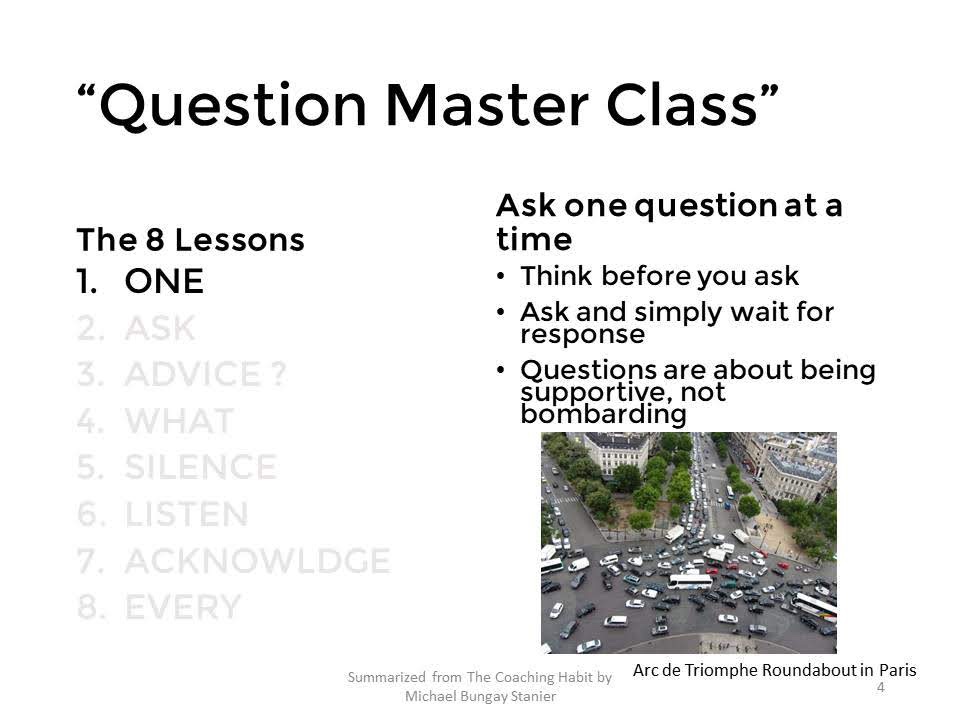
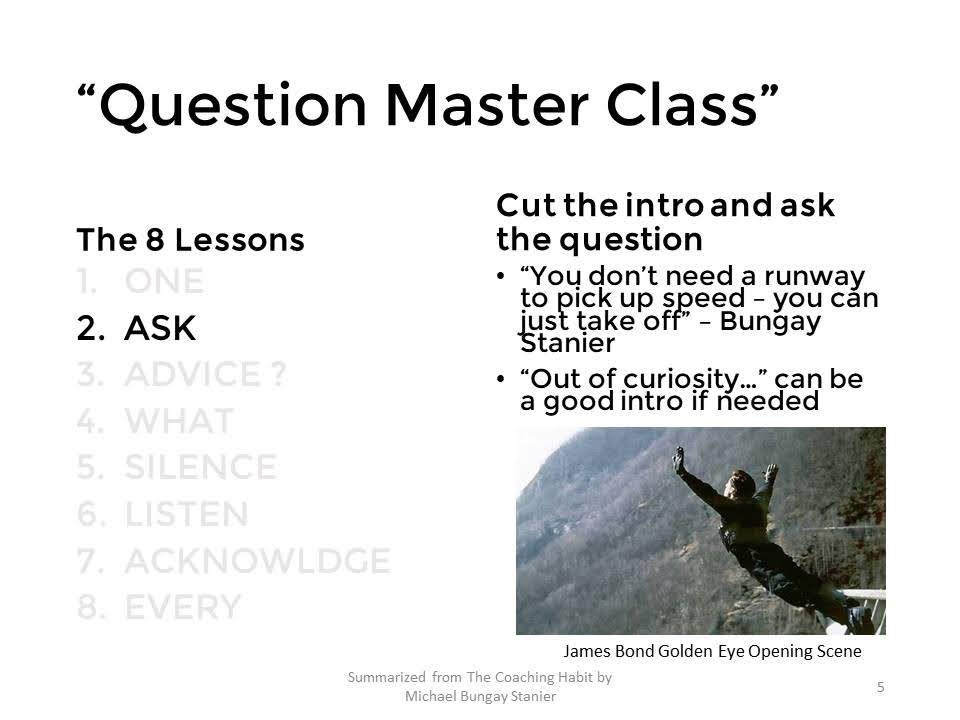
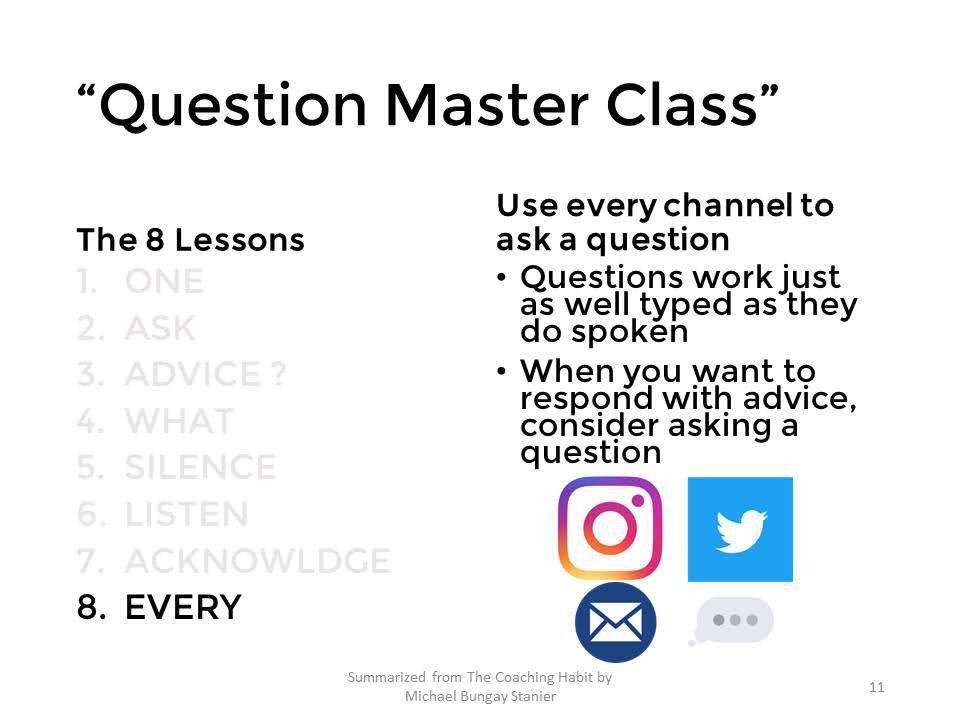
Idea and examples come from Michael Bungay Stanier’s book The Coaching Habit where he offers Question Master Classes. This is one of those nuggets of gold from this book!

Check out my entire reading list

Coaching Experiments Don’t Produce the Same Result

In a lot of ways coaching is like jazz.

Jazz has a general structure, a rule of thumb, but ultimately is defined and know for its improvisation, personality, and spontaneity.

Ted Gioia in How to Listen to Jazz says, “When the jazz experiment is repeated, it never produces the same result.”

The same can be said of coaching. There is a structure and framework but a good coach will improvise and revise based on the client.

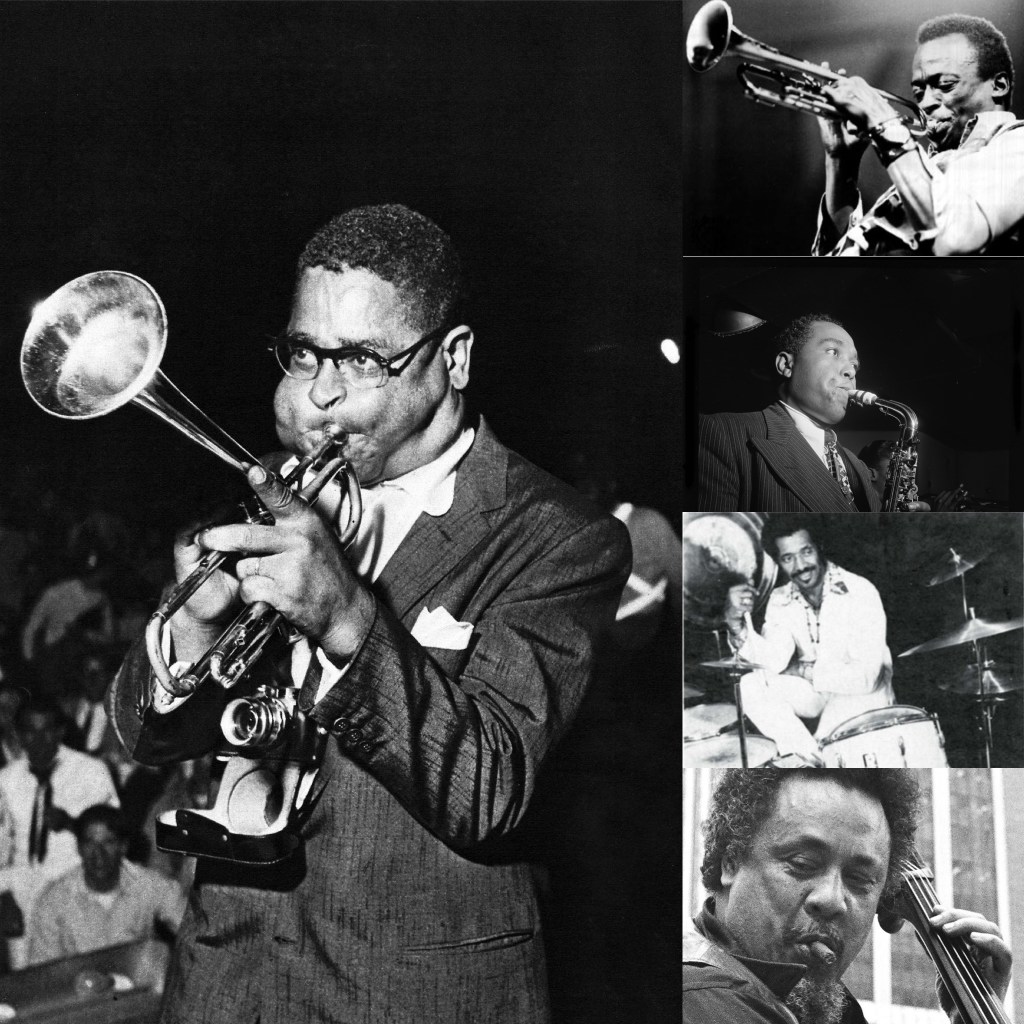
Listen to Salt Peanuts. There are hundreds of renditions of it in jazz. Each one takes on the persona of the artist or band. Notice the nuances in each and enjoy each. Some might be more enjoyable but none of them are the same.

Left to right, top to bottom: Dizzy Gillespie (originator of Salt Peanuts), Miles Davis, Charlie Parker, Philly Joe Jones, Charles Mingus. Each have their own and multiple iterations or Salt Peanuts.

Consider how you can ensure you are ready to offer variety and personality in your coaching, question asking, interactions. Don’t hesitate to use a framework or reliable resource but keep it fresh.

Grounded for Questions

If we want to be primed to ask the best questions, we must first be grounded.

To be grounded, we need to remember what we truly have influence over and what we don’t.

Especially when asking questions, if we worry about what we can’t control (circle of concern) we give up our power and make less impact. We need something from the person we are asking the question.

If we instead focus on what we can control (circle of influence) we will be ready to listen and offer a generous question. With readiness to hear.

We can’t use questions to get our way but rather be independent ourselves and ask questions to allow the other their independence and urge all of us towards deeper understanding.

Questions are there for listening

When we want to ask the best questions, we must first be willing to listen.

Questions aren’t a way for us to convince someone but a way for discovery to occur.

We must be grounded and trust the question for it to be a good question.

Questions help other people come to conclusion, go through a process of understanding and critical thinking.

Questions are there for us to understand the other and ourselves and the work around us. A question is a way for us to grow in our own understanding.

Be curious.

Inspired by Michael Bungay Stanier’s the Coaching Habit as I turn the book concepts into a training.

Integral

Integral is the goal of development of SELF in coaching.

Integral: Essential to completeness; lacking nothing essential; composed of constituent parts

(Constituent: an essential part)

As you understand your strengths, weaknesses, and life theme, you work towards bringing the essential, important parts of yourself together to be united and applied around you.

Start with Strengths

What was the last new habit you formed? Or the last time you got a lot of work accomplished?

How did it start?

You decided to vacuuming the living room and ended up cleaning your whole house, even started unpacking those boxes in that closet you never open…

You took a simple jog through your favorite part of the city and now you’re about to run your first 5K…

You read a short and funny book over the weekend and now are checking if your library has books more like it…

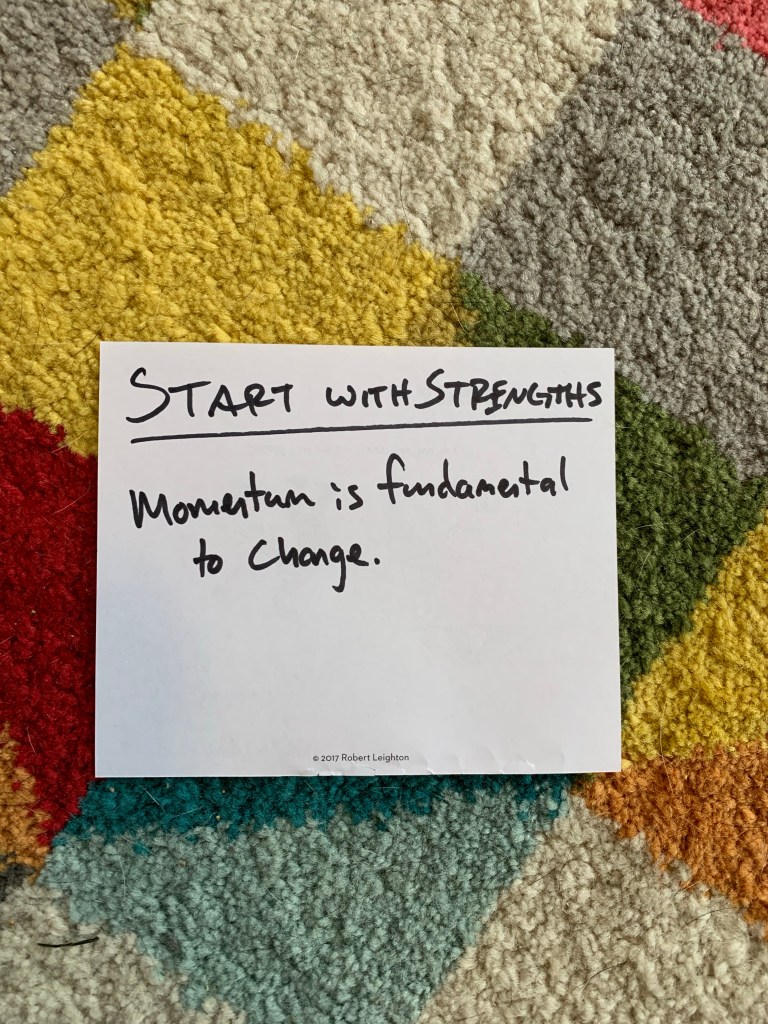
Momentum is fundamental to change. 

That’s why our coaching framework starts with strengths. What are you most talented in? Where is the room for greatest potential?

It’s like choosing your favorite chore around the house, doing an exercise you enjoy, finding an approachable book.

Starting with strengths builds momentum into the change you see to make.