Limits to Growth

Peter Senge, in the Fifth Discipline outlines how we can understand systems around us and the importance of pulling the right levers and being aware of what other levers change when we do pull certain levers.

One “archetype” of a natural system at play in most areas of life is “Limits to Growth.”

From The Fifth Discipline by Peter Senge (Limits to Growth)

As we work to expand something, grow something, do a function more we need to be aware, there may be a limiting condition around the corner.

A farmer may grow a crop using fertilizer only to grow more than what the average rainfall of the area can sustain.

We may work a few more hours each day to get some work done but the stress adds up and we notice our internal limits are exceeded causing us to be burnt out.

A new area I noticed (thanks to the help of a friend and colleague who outlined their plan explained below) is when we think of expanding a service or function in an organization.

Consider a new initiative that is yet to have full organizational support but is widely successful and impactful. Many around the organization see its value and want to support the initiative…maybe its a new diversity, equity, inclusion initiative.

But it may be missing key top leadership support or have a limited budget.

You could expand the initiative out and continue to push it to the masses who you know will love it, adopt it, and move it forward. However, eventually you will have so many people wanting to join in that you will need to hire more people or expand the budget or need deeper support from top leaders. All this can make the growth unsustainable. People will be annoyed by your lack of responding to requests or feel let down by the expectations that were not met or leaders will divest in the initiative because it has gotten beyond what they initially supported.

To solve this, we can think of the initiative as concentric circles.
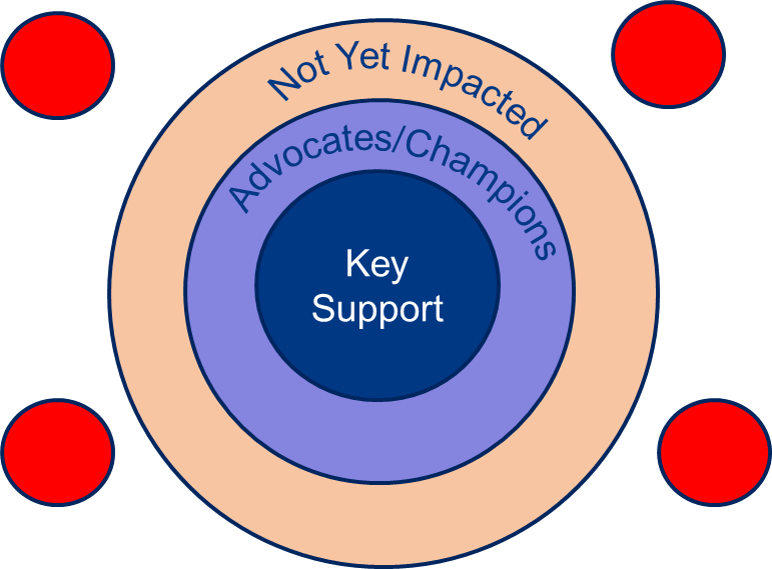
The center circle is your key support. Executive leaders bought into the initiative. Budget commitments to grow the movement. Key influencers and stakeholders.

The second circle is your advocates or champions. People who will do a lot of the hard work to make things happen. These people would likely be bought into the initiative no matter what but do not have as much organizational power as the key support.

The outer circle are those who are not yet impacted. Your “outreach” or those you can impact and get support from if they knew more about it.

Beyond the outer circle are other smaller circles of people who are likely resistant to the change. Often it’s difficult to get them bought into the change. It is worth evaluating if there are too many little outer circles to make the change effective but often best to not manage to their needs or expectations if the change is truly needed.

The error that can be made is to expand the outer circle. Focus all effort on growth and expansion of the initiative. Push harder. However the inner circle is your limiting condition. Peter Senge says the key to leverage with this model is identifying and changing the limiting condition.

For the concentric circles, focus first on growing the inner circle of key support. Expand there so as it grows out, it can be sustained.

Sometimes we need to keep outward growth going while also investing on the limiting condition. We can’t slow the outward growth but need to also focus priorities on the limiting condition.

It may be easy to stop there but we should not. There will always be limiting conditions after we remove or remedy one. Be on the lookout for what could be the next limiting condition.
Start Stop Continue

A great mechanism to make an action plan to make a behavior change. At the end of a reflection process, coaching session, meeting, you can write down what you will start doing, what you will stop doing, and what you will continue doing.

For example, I read a recent article on making diversity more than a business case and here are my Start Stop Continue in follow up:

Start: Clarifying and sharing my own personal motivation to work on equality initiatives.

Stop: Accepting the business case for diversity as enough motivation to make change occur.

Continue: Encouraging people in coaching and other situations to create person vision statements and emphasize the importance of this.

It works because it’s easy to remember and gets to the heart of change, behavior and rhythms.

Don’t forget: More like jazz. Less like classical.

Coaching: Helping Someone Solve Their Problem

Key word here: THEIR

Successful coaching is not about telling someone your view of what could be better or giving someone steps to follow. It’s about the person being coached.

They may have an idea of what better looks like. They may ask for your help in defining better. You may have to do some “marketing” to help them see and in turn own the better.

We can use stories, status roles, creating and relieving tension, build culture to help someone adopt and enroll in a journey.

This marketing is not about a website or a logo. It’s about designing the coaching experience for the coachee and helping them solve THEIR problem.


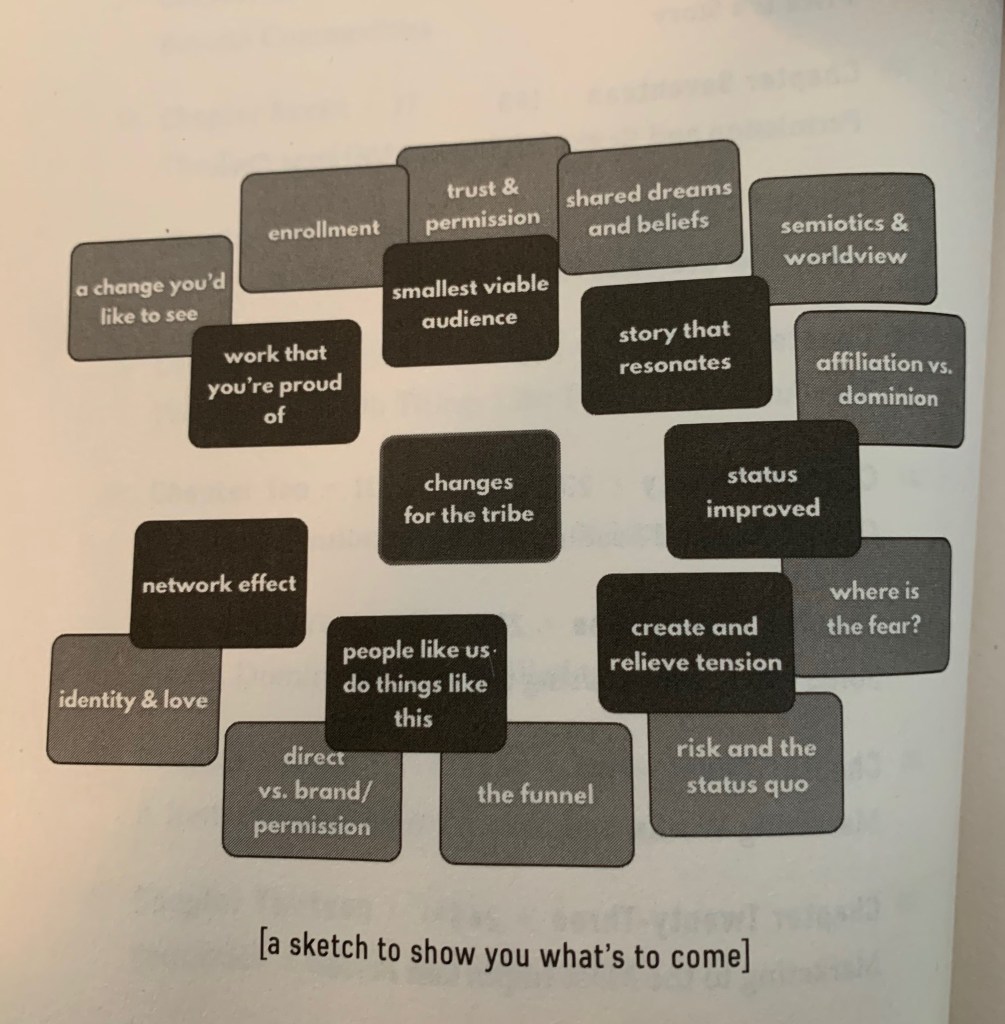
These ideas all are elaborated on in Seth Godin’s This is Marketing. I love the “table of contents” in image below!

Change Calls for Sacrifice

Any change we make, political or policy change, organizational change, personal change, requires something to be sacrificed.

Maybe you want to workout more, hours of sleep is going to sacrifice.

If we want to change policy so those who are oppressed have burden lifted from them, we have to put a burden on someone else…that is of course if it’s a finite system…maybe our economic system is not as finite as we think…

Anytime we shoot for change, we should identify what is sacrificing. And choose the structure of the change with ideal sacrifice.

This is easier thought through and applied with personal change because it’s a system we understand. More complex policy or political system have been made complex and are tough to understand and change.

Anytime you look to change or grow, call out what you’ll be sacrificing and accept that. Change then can come with more clarity and swift results.

Build Confidence in Change

When change comes, do you embrace it and adapt or resist and fight?

Often we resist change because a lack of confidence.

Two ways to build confidence as you embrace and adapt in change:

1. Look back and remember times you’ve had success. Think of the generalized skills that allowed you success. Summon those skills you have.

2. Break the change into smaller goals. More visible and attainable steps. As you check things off you’ll spur momentum and assurance.

Even though…

We want to know the next right step. The box to check off. The category to put someone.

All so they can fit our process…really so they can fit into our current world view or perspective.

This is the case with people interactions on many levels. When coaching someone. When leading someone. When trying to sell to someone. When debating with someone.

And yet we are only pushing people more and more apart.

We think “if only they would see it as I do…”or “if only they would appreciate this concept…”or “if only they would prioritize the right thing…”

Instead of saying “if only…” we should take the approach of “even though…”

There is a way through it just may not look like you expect. The person may not fit your typical coaching framework. They may not need what other people you’ve led have needed. They may not value the same things you do.

We need to go where they are and see it as “even though…”

Even though they see it differently we find a way to serve. Even though they value something else we can help get a good outcome.

It becomes less about us and more about purely serving the other. The route may not be clear but that’s the fun in it! There will be a surprise around the corner and that challenge alone can spur us onward.

What stories are you telling yourself that benefit from an “even though” mindset shift?

Learning and Accountability

As we undergo change, learn something new, grow, we need to keep accountable to make the change or apply it to our daily lives.

Sometimes we can learn and keep ourselves accountable.

Most often I find I best apply my learning and growth when it’s done with others. They help me learn deeper as well as stay motivated to put the learning into reality.

Find a cohort. Find a colleague. Find a partner to go with.

You’ll probably make the most of your investment of learning or change if you have people along for the ride with you.

Offer a New Map Instead of a Compass

Often we don’t have leverage to change someone’s mind.

If someone doesn’t know how to use a compass, they likely won’t pick one up.

But if they already are holding a compass, we can show them a new map. Maybe an updated version or a different territory.

Sometimes someone may not have a compass but we can point out the mountains in the difference. They may not have a compass to get there but we can meet them where they are and help towards some change.

When someone is ready to learn to use a compass, we’d better not bombard them with the map but teach them to use the compass first. Being ready to also meet them where they are.

We need to know our audience and build what we offer based on that or be brave enough to say, “This isn’t for them.”

What is the compass needed to navigate?

What is the new map you could offer?

Who is your audience?


Seth Godin discusses this idea at the end of this podcast in the question section.