“Be a better leader” translates to:
Be a better person for the sake of others.
“Be a better leader” translates to:
Be a better person for the sake of others.

Buechner is describing sloth as what I understand as incessant flow.
When we are focused but not aware. This is valuable in some instances (doing the dishes, tedious but necessary work…) but if it becomes a norm, it can derail and lower meaning in life.
The alternative is mindful. Focuses and aware. A mindful person can be seen as lazy sometimes because they take a walk after a complicated phone call. They spend extra time meditating each morning. They don’t rush out of a conversation.
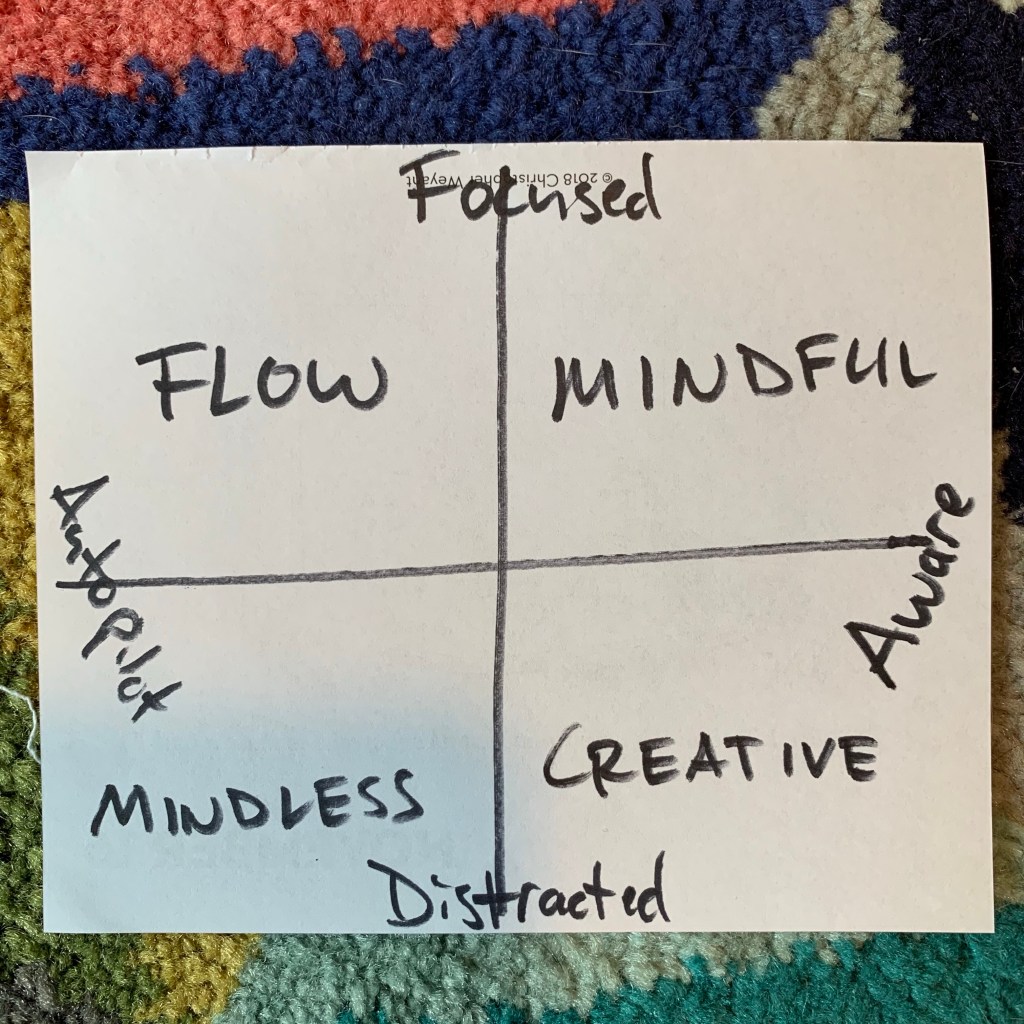
Mindfulness practices has helped me tremendously to not have sloth but occasionally look lazy while bringing my best to those around me.
Focusing on our weaknesses or liabilities is like tightening a ratchet. It is effective to a point. At some point we get so tight, we break or we can’t go any tighter.
Focusing on our strengths is like using a machete to create a new trail. It is endlessly fulfilling and possible. We can continue to go down the path we are on and start creating a new path on a whim. We have momentum and power here.
We have to use both to grow. Sometimes its about a little ratchet tighter and hopefully more often it’s about the endless possibility of cutting out a new path.
When we are operating just beyond our comfort zone or current skill level, we benefit from having scaffolding around us.
This is a place for a coach. Someone who can help you consider the next step, provide a push back on track as we get off, help us feel more certain.
Where could a scaffolding coach help you?
Where can you be a scaffolding coach for someone else?
Just because we are not isolated does not mean we are not insulated.
Change, progress, movement, improvement, growth happens when we ensure we are not isolated as well as not insulated.
Exposure. Reflection. Conceptualization. Application. Repeat. This is the route to growth. Any isolation or insulation will only slow/limit this growth.
David Kolb’s learning styles as well as Tara Fenwick’s practice-based-learning talks more deeply about this concept. Ed Batista summarizes and adds to Kolb’s Learning Cycle.
I see a new blog post that intrigues me.
I read a book where I’m feverishly underlining.
I listen to a podcast and I find myself continually going back 15 seconds to write down what someone said.
All this is not enough for me.
In order to truly grow, we must deeply consider and apply ideas and concepts.
This is best done among others.
Hearing and seeing what others are learning.
Getting energized by the way someone else is applying a jointly learned concept.
Being challenged to stretch thinking and imagine beyond your status quo.
Starting mid November 2020, I’ll be hosting a Coaching Round Table.
A space to share what you’re learning, hear what others are learning, and go together to be better.
We will focus on topics around coaching and leadership. However we will break down the walls of considering how this applies to a day job.
“Who we are is how we lead.”
Brene Brown on the Dare to Lead Podcast
If you’re interested to join, complete the form or email me.
We will all be better if you are there. Hope to see you around the table!
Go take a walk
  It is easy to hear your own footsteps,
  the rustling of the leaves you kick,
  the crack of a branch you break.
Listen also to all that is beyond yourself.
  The breeze shaking the leaves,
  a creak of an old tree,
  the quip-quip-quip of an unfamiliar bird.
Be led beyond yourself.
  Sense and feel that which is other,
  consider from where it comes,
  acknowledge, honor, and respect it.

My most effective journaling has been when I focus less on what I did and more on who I am being.
Sometimes I get to who I am being by first writing or thinking through what I did.
Try to end a journal entry with this question…”If this is what you did, who are you being?”
Answering for yourself is most important. Here’s where my heads been:
Personal life having proper priority. Work not chipping away at personal life priorities
Predictability in work needs. Be specific here. For example: schedule for a day is set 3 days ahead. Knowing rough schedule 1 week in advance
Time within work week to handle urgent needs inside work time
Time in work week to complete all important needs
Time in work week to process and think and ultimately close out mental each day. Avoid carrying stress of work past work hours
Knowing ahead of time when non-traditional work time needed…after hours
Knowing ahead of time when busy week is coming
Flexibility to step away from work when urgent personal needs arise
Work day is energizing more often than it is not
Organization of work projects to keep straight and aware of with ease
Confidence and assurance my career is going the direction I want
Connected to the pulse of those near me…perceptions, attitudes, opinions…no guesswork in what those near me are thinking
Not being beholden to opinions of others. Having grit and autonomy to not act according to opinions unless in line with my goals.
Not being in a hazardously competitive environment or at least not defending on success in this environment
Aware of my current stressors and have control over some impactful aspects of them
Me and others having clarity of what I stand for
Close teammates and boss challenge me yet recognize autonomy and all value balance
Work values and duties aligning with personal values…no erosion of ethics and congruent work-life and personal life
Work makes me better outside of work
Pay of work allowing for comfortable financial life and financial goals to be attained
What would your list be? To have work-life balance we need to first define it for ourselves.
We all aspire for healthy work/life balance.
Some of us may feel we have it good right now.
Some of us may feel we are drowning in work and need a way out.
Either way, we must be proactive, not defensive.
Defensive: fight back and push against. Say no more often. Negotiate better terms. All these are necessary at times but not optimal.
Proactive: build a leadership style that creates ownership of others. Set other people up for success and give them freedom to run. Build a personal brand that highlights your priority of family or personal life.
This is important. Erosion of work/life balance will lead to burnout and poor leadership. Build it in now. Be proactive where you can.
 phil invites