When we face a truly unique or difficult challenge, we are unsure of the outcome.
Some challenges, we can be certain how they will end and in those situations are they really challenges?
I’m looking for more challenges in which, I’m uncertain of the ending. I’m uncertain of the solution. I don’t know the right answer.
This propels a new motivation inside of me. One of anticipating and seeking out the surprise.
As I work towards solving a problem with very unknown outcome or path, the surprise is exciting and engaging. At the end of a working session, I will see something anew. See the world a different way. Realize a truth about myself I did not know. Distill a solution which feels original to me.
To me, these are the challenges worth investing in. Not to overcome fully but to seek the surprise and grow from it.
I heard of this ideaon a podcast featuring Austin Kleon where he describes his favorite part of the creative process being the surprise during that creativity.
We tell ourselves stories all the time. These narratives can be subconscious or we might be aware through mindfulness, journaling, reflection, outside perspective.
Once we realize we are telling ourselves a narrative that is not constructive to where we seek to go, we must replace it with a more ideal narrative.
I’ve found the practice of journaling to help with this.
I write out the current narrative I’m noticing. Cross it out. Write a more ideal narrative to replace it.
This ideal narrative doesn’t need to perfect or full proof. It simply needs to one little step better.
An example:
I need to do more to get to where I want to be. Who I am is enough and I am putting in the work to get to where I want to be.
Keeping a journal and the active practice of journaling has been a critical piece of my own growth and mindfulness.
I increase my own ability to reflect and be aware of what was and what is and what is to come. By looking back or looking ahead, I grow in awareness. I also grow in focus by looking specifically at a certain moment or experience.
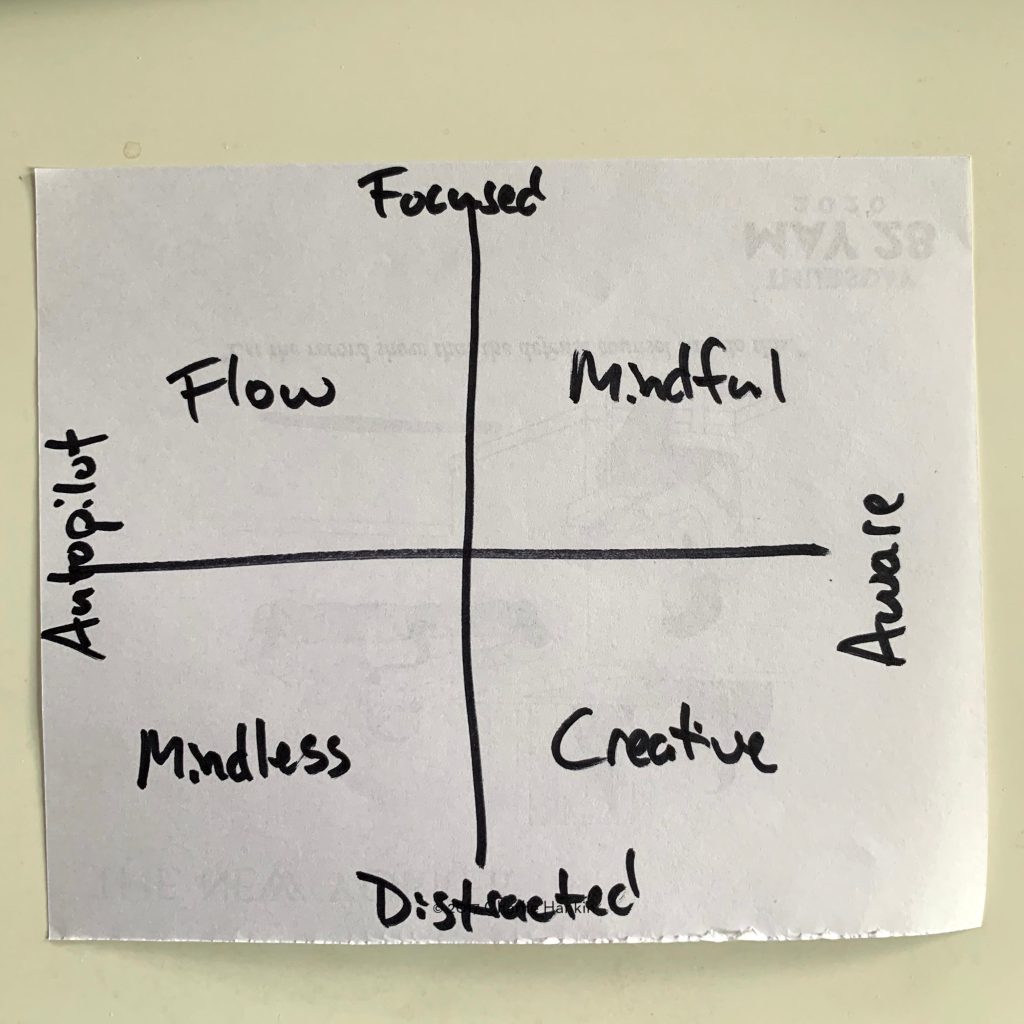
In The Mind of the Leader, they identify mindfulness as a combination of heightened awareness and heightened focus.
Journaling helps me operate in the Mindful category more effectively.
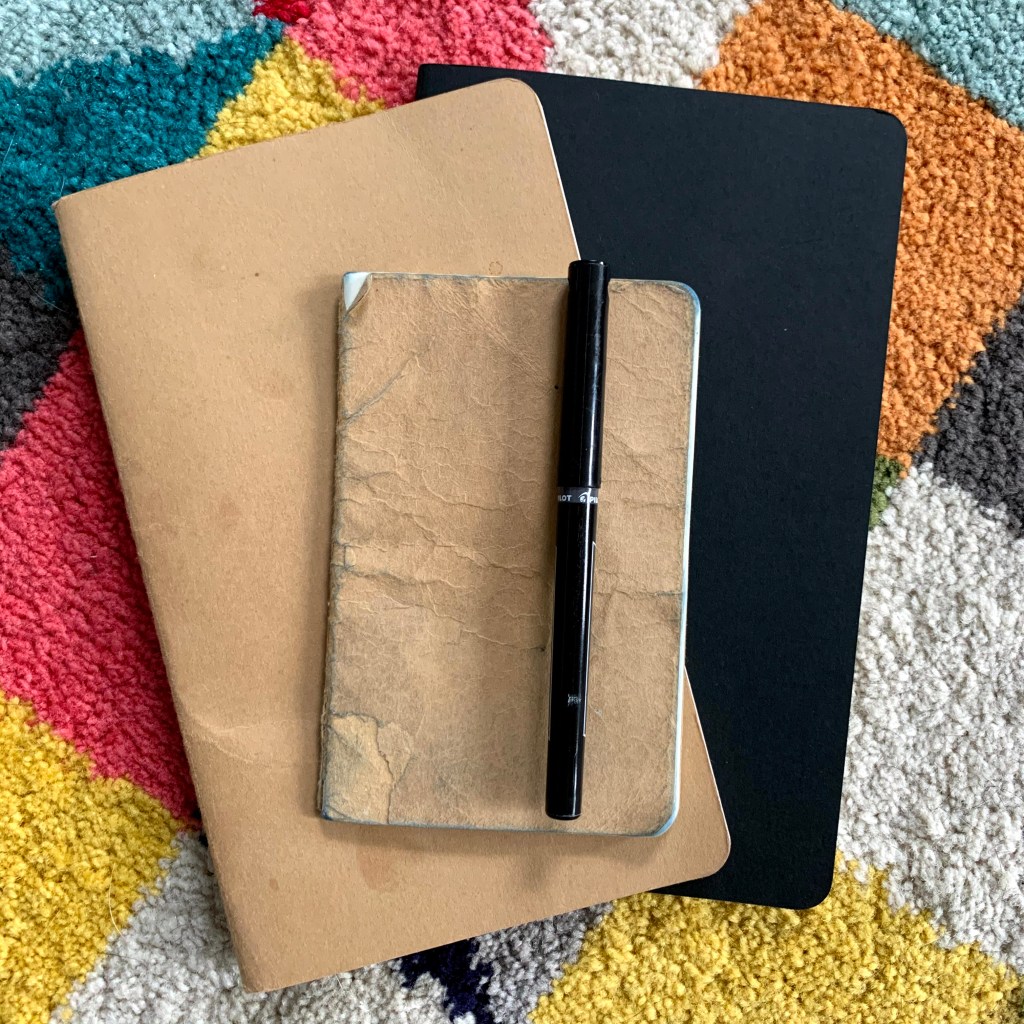
I have 3 distinct journals and ways I use them to keep a journal and journal practice:
Pocket notebook: Small Moleskine notebook I keep in my back pocket with me at all times. Pen in my pocket to write down little ideas I have them or things that stick out in a podcast, book, random conversation. When I stop to write in my formal diary each day, I reflect on notes I wrote in it that day and day before.
Note taking notebook: Large sized Moleskine notebook I bring with me if I’m intently reading something, going to a meeting, or need a place to track more thorough note like ideas or topics. I will typically take a photo of this and load it into my Microsoft OneNote in some sort of order for log. I also keep this next to me and check it as I do my formal diary each day.
Formal diary: Large sized Moleskine Notebook (black in picture). Eventually will migrate to a hard covered notebook. This is where I write each day at the end of my work day and reflect on what stood out. Throughout the day I’ll pull it out and jot down more reflective thoughts. I make a point to fill at least 1 page in it each workday. I try to do this on the weekends also but find it’s important for me to be lax on weekends. This is where the depth of my mindfulness increases in keeping a journal. I expand upon thoughts I might not share but want to dive into. I take those ideas and sometimes will formulate a blog post on it or use it in coaching or training. I also paste pieces of magazines or things I print out into it. Right now I’ve been taking pictures of a specific scene and joining them together into a collage as a ‘joiner‘.
This practice will evolve and change over time but I intend to continue a habit that increases my own awareness and focus.
Our typical meeting model or conversation model is all surrounding attention.
Now that everyone is in the same room, let me talk at you. Now that you’re done talking, let me tel you a story.
I’ve been forced to refine how I connect with people with increased digital connection. We cannot guarantee we have anyone attention (well we never have been able to but even more evident now).
This requires attaining enrollment.
The other person or people choosing to listen and engage. This type of engagement gains much more success and effectiveness than simply having someone’s attention.
Now that I have you together, I’m going to compel you to hear me out. Now that you’re done sharing, I will ask a question to dive deeper. Now that we are connected, I’m going to add something that you add valuable.
The focus of the interaction is less about us getting our way and more about us creating a space for the other to engage in a way that honors them. It’s service oriented. It’s other focused. It’s empathetic.
Take the chance in front of you to not just someone’s attention but enroll them.
Seek enrollment and gain awareness when you’re only seeking attention.
The things I enjoy most are the ones I feel confident in. Not necessarily confident that I will do it well but confident that it is true, good, and at times that I will do well.
This confidence comes from preparation, certainty of expectations, practice.
Today I taught a scientific technical course which I have no hands on experience in yet is a very hands on concept. Even though I have no physical experience, I have thorough notes on the training. I’ve watched someone else give the training twice and taken notes of what they said, when, and to what context.
This enhancement led to confidence. Confidence led to improvement.
Enhancement for this was me taking notes on the training. Improving my preparation.
What else can I enhance to lead to higher confidence leading to more satisfaction and enjoyment. Even though I don’t particularly like something, doesn’t mean I can’t have confidence in it.
Giving feedback is a key piece of coaching someone or simply doing life with someone. We may avoid giving feedback because it can be difficult to articulate or we are concerned of the relationship.
If you find yourself mustering the courage to give direct feedback, positive or critical, be sure you explain why that thing worked or it didn’t work.
We increase our feedback game when we can explain to the person why something worked or didn’t work. This might take extra research or knowledge gained over time.
If someone gives a presentation and they delivered well. Our easy response is, “You did a great job! Keep it up!” This does little for that person. It may encourage them but ultimately understanding why it went well builds truer confidence.
Be specific about what is working and why it’s working. If you’re receiving feedback from someone, ask them more about it. Maybe ask, “What did you enjoy most about this?” or “Why do you think people appreciated the presentation?”
The “what” is helpful but even more helpful in feedback is the “why.” Maybe we can give someone the “why.” Maybe we can ask for the “why” when receiving feedback. Maybe we need to seek out the “why” after we receive that feedback.
I’m working to research and learn more so I can continue to provide people with better “why” in feedback.
I first heard of this idea from Sally Perkins (a storyteller and storytelling coach) when she was on the Practice First Podcast. I recommend listening!
As we coach others or simply help people solve problems, it’s easy to over complicate the situation or get distracted by too many options.
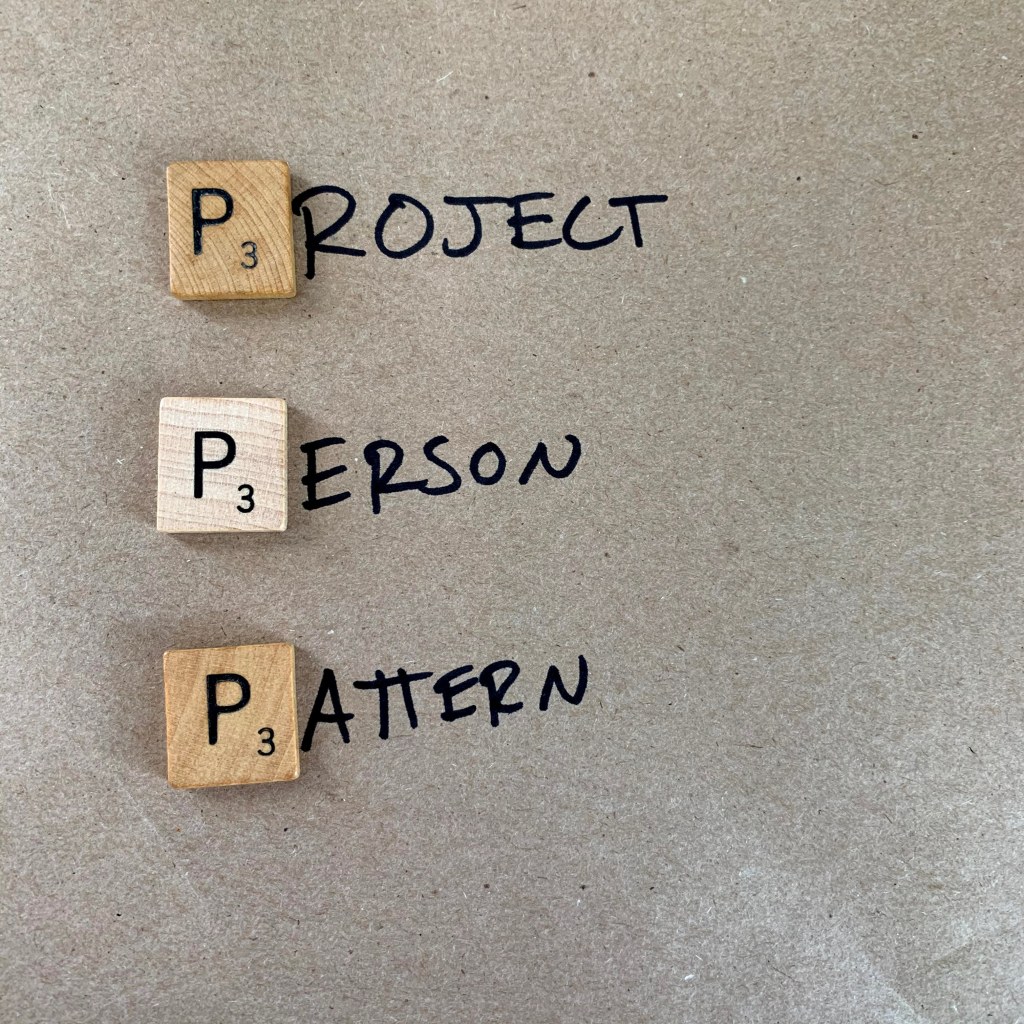
Use the 3P’s to focus your conversations and questions you ask.
Consider how you can focus in on the Project the person is talking about or struggling with. This is where technical or strategic conversations happen.
Ask questions about the Person or people involved in the situation and help the other person see how to impact the relationship.
Challenge the person to modify their Patterns in life to get the outcome they desire.
Rather than just dance around the complaining or the struggle, get specific and use one of the 3P’s to help you get there.
Of course anything we do in coaching someone else, we should apply to ourselves. Find ways to use the 3P’s to help yourself solve problems and focus in on resolutions.
I first read about the 3P’s from Michael Bungay Stainer in his book The Coaching Habit. I’ve written more about The Coaching Habit on my blog HERE.
The stories we tell ourselves shape our perceptions and hence our attention and then our actions and then what we get. Narratives are powerful in our life and they are everywhere.
From what we put on when we get up, to how we talk to our co-worker, to what we career decisions we make. Narratives drive our world.
If we are attempting to overcome a challenge, we may have the following narratives:
“I just need them to get out of the way!”
“I need their help to get through this.”
The key word here is need.
Need is an extrinsic attribute. It relies on someone else. Because of this it automatically puts us in a victim mindset. We can’t do anything but explain our need and let them do what they want.
An alternative is “want.”
“I want their help on this.”
This is an intrinsic motivator. The story is flipped from being about the other person needing to do something to us having a desire for something.
By simply turning this story around a little, we gain even more power in it. We see ourselves as a key part of solving the problem.
The challenge then becomes a motivator rather than a burden.
What challenges are you facing?
Where can you move from a “need” narrative to a “want” narrative?
Reading captivating and informative news or posts online have huge value. They ensure we keep ourselves connected to the pulse of change and the momentum of society’s movement towards racial equality. Here in the United States, there is new information being posted hourly on how to be involved in our country’s wide awakening to racial injustice. Reading books has allowed a space for me to process the news and posts I consume while gravitating towards deep personal change and plan civically.
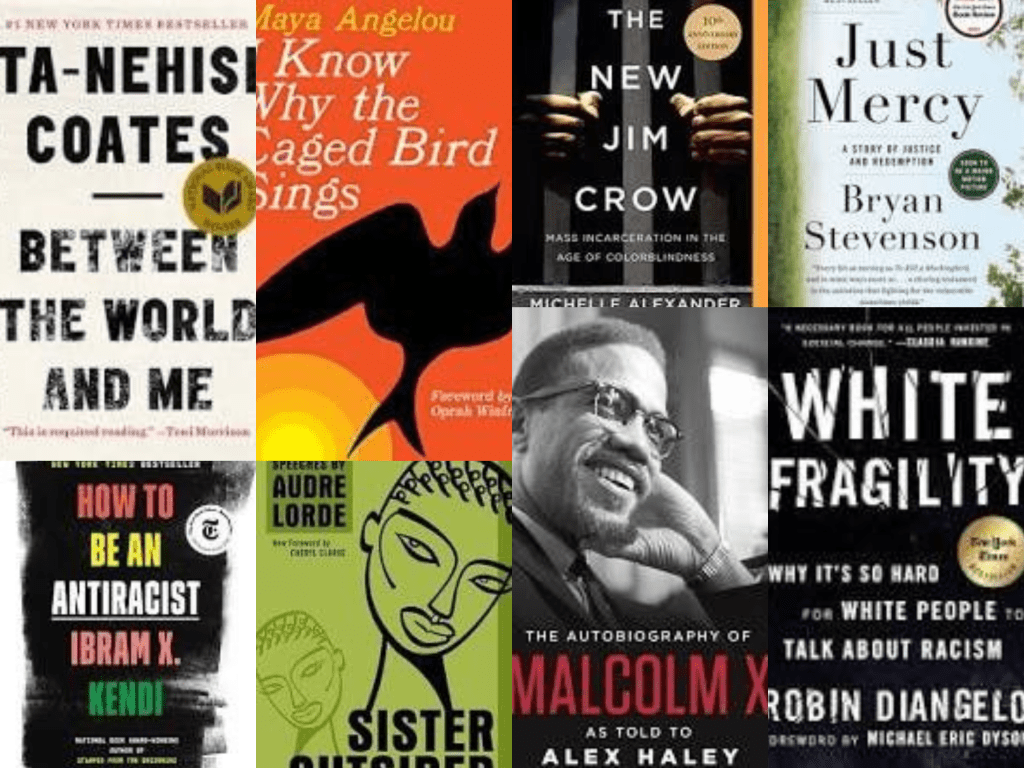
Here, I recommend 8 books which have helped me in my journey towards understanding racial injustice and working towards racial equality. I must recognize my recommendations come from my white American male perspective. I intend to center on Black, Indigenous, People of Color (BIPOC) voices in this time of pushing toward justice and equality. To that end, much of my post below is shaped by Ibram X. Kendi’s article in the Atlantic and recommendations from my local social justice movements.
This recommendation should not be used as a checklist but an inspiration to begin or continue to fight racial injustice everywhere. This list is not complete, and not universal to all, but I hope in hearing my journey you are encouraged in your own. Links to each book below are to a non-profit book provider supporting local book stores but I recommend you find a local bookstore to support.
Just Mercy by Bryan Stevenson: As I work towards gaining understanding and awareness of racial injustice, it is important for me to start with stories of people’s experiences. Just Mercy: A Story of Justice and Redemption is written by the lawyer Bryan Stevenson who has spent his career serving those in most need. He focuses on the story of Walter McMillian, who was a young man sentenced to death for a crime he insisted he did not commit. Just Mercy showed me the challenges that Black people face in the criminal justice and policing system. I felt things I had never felt before and was moved by this powerful, real life, tragic story of how the justice system fails Black people in the U.S. The book was recently made into a motion picture starring Michael B. Jordan and Jamie Foxx. You can watch it for free right now for a limited time.
White Fragility by Robin DiAngelo: If you are a person who is white, looking to expand your knowledge in racial justice but limited on time to read, I recommend starting with this book. This book (written by a white author) sets the stage for what it means for white people (specifically white Americans) to step into allyship for racial justice. This book helped me realize the nuanced ways white supremacy, my own racism, and racial bias affect my actions. In addition to pointing out where other people and systems are propagating racial inequality, I begin to see even the smallest things I do which perpetuate racial injustice and inequality. After reading this book, I have language to explain my movement away from contributing to the toxic systems of White Supremacy. This book comes from an author who is white and is written to a white audience. It should be noted that Ibram X. Kendi recommends BIPOC individuals to read Locking Up Our Own by James Forman Jr in substitution for White Fragility.
How to Be an Antiracist by Ibram X. Kendi: Racism feels like such a dangerous, scary word. It is a hazardous system and it is highly ingrained into our society. This book helped me see racism for what it is and how racism functions in society and at times, through me. I would not have a good definition for racism or antiracism before reading this book. I understand from this book there is no neutral party in racial inequality. You cannot be between justice and injustice, equality and inequality. The author, Ibram X. Kendi, powerfully breaks down how racism shows up around us and how we can strive towards antiracism.
Between the World and Me by Ta-Nehisi Coates: Ta-Nehisi Coates generously shares with readers his advice to his son on how to go forward in life as a Black man in the United States. This memoir breathed life into my desire to be an ally and advocate for my Black friends, neighbors, and fellow humans. Coates does not sugar coat any piece of his experience and leaves a raw, historical, and wise outline of his experience being a Black man in the United States.
The following books are ones I have not yet read but are next on my reading list:
I know Why the Caged Bird Sings by Maya Angelou: My own reading reflects the voices of mostly white men, Black men and white women. I hope to learn the story of a Black woman from Maya Angelou’s iconic memoir. The memoirs of the past and present can lead our feelings and actions after realizing our own and society’s racism.
Sister Outsider by Audre Lorde: These essays of Audre Lorde are said to bridge connections from understanding racial inequity to gender and sexuality inequity. This book is next on my list, as it speaks from the intersection of race and sexuality, adding voices from the LGBTQ+ community.
The Autobiography of Malcolm X: Malcolm X was not discussed much in my formal education around race. I am reading this on recommendation of others and looking to understand Malcolm X’s transformation. From that I hope better to understand the Black Lives Matter movement and the history of social justice in the United States.
The New Jim Crow by Michelle Alexander: I’ve often heard and understood (from Just Mercy), the criminal justice system in the United States disproportionately incarcerates Black men. This book is said to reveal how deeply rooted and preserved systemic racism is in the United States. I hope to understand the systems at play and see my role in standing against this racial injustice.
If you would like to discuss anything you read in the list above, or have other recommendations, please do not hesitate to reach out. I am always looking to learn from and alongside others.
As we all stand for equality and oppose injustice and inequality we have a lot of work ahead, both civically and within ourselves. Ibram X. Kendi on Brene Brown’s Podcast, Unlocking Us, put words to how I’ve felt. “Once we realize we have been running away from recognizing our own racism, we cannot help but run towards antiracism and racial justice.”
 phil invites